





Missouri Workers' Comp Settlement Chart by Body Part
What your injury is worth under Missouri law, with current DWC rates
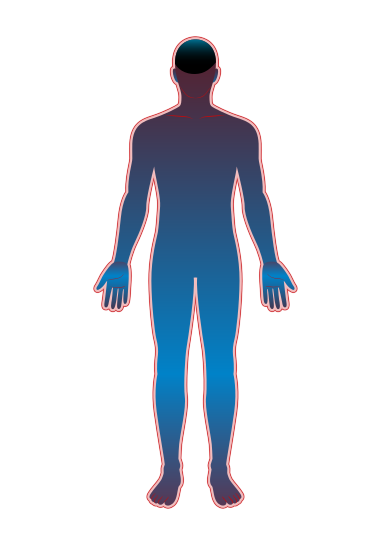
This Missouri workers' comp settlement chart shows the value the law assigns to each body part under Missouri's schedule of losses. Every part of your body is worth a set number of weeks of pay. Click a body part below, enter your wage, and see the math insurance companies use, before they show it to you.
Click a Body Part to See Its Value Under Missouri Law
Select an injury, set the disability rating, and enter your average weekly wage. The calculator applies the actual Missouri formula, statutory weeks times your percentage of disability times your PPD rate (66 2/3% of your wage, capped at $678.18).
Click a body part or search above
Select a Body Part
Click on the body diagram or use the search above to view PPD benefit details for a specific injury.
Benefit rates shown reflect the PPD maximum of $678.18/week for injuries occurring July 1, 2026 through June 30, 2027 and are subject to annual adjustment by the Missouri Division of Workers' Compensation. This chart is for informational purposes only and does not constitute legal advice. Individual case values depend on your specific injury, medical evidence, and average weekly wage.
Rates shown reflect the Missouri DWC maximum for injuries occurring July 1, 2026 through June 30, 2027. Estimates are informational only and are not legal advice or a promise of any result. Every case is different.
How Missouri Calculates a Workers' Comp Settlement
Missouri does not pay for pain and suffering in a workers' comp case. Instead, the law converts a permanent injury into money using a fixed formula. Once you know the three inputs, you can check any settlement offer yourself.
1. Statutory weeks come from the schedule of losses
RSMo 287.190 assigns each body part a number of weeks: 232 for the arm at the shoulder, 175 for a hand, 160 for the leg at the knee, 150 for a foot at the ankle. Injuries that are not on the schedule, including the back, neck, and head, fall under the "body as a whole" at up to 400 weeks. The full list is in the schedule table below. And if a scheduled loss is total, by amputation or complete loss of use, the weeks increase by 10%.
2. The percentage is where cases are won or lost
Nobody disputes the weeks. The fight is over your percentage of disability. Missouri law requires the disability to be demonstrated and certified by a physician, and where medical opinions conflict, objective findings prevail over subjective ones (RSMo 287.190.6). In practice, the insurance company's doctor rates you low, and that rating becomes their offer. You are allowed to obtain your own rating, and the difference between the two numbers is usually where the real negotiation happens. Missouri also reduces awards for preexisting conditions, which is another place adjusters push harder than the medicine supports.
3. Your PPD rate is 66 2/3% of your average weekly wage
The weekly rate applied to those weeks is 66 2/3% of your average weekly wage, capped at 55% of the state average weekly wage, which works out to $678.18 for injuries occurring July 1, 2026 through June 30, 2027. The cap binds once your gross wage exceeds $1,017.27 per week, so many full-time workers hit it. Getting the average weekly wage right still matters enormously: overtime, a second job, and short work histories all change the calculation, and a wage set even $50 too low quietly shrinks every week of your award.
3 Example Settlement Calculations
Each example shows the same injury at 2 wage levels: a worker earning $900 per week (PPD rate $600.00) and a worker at or above the $678.18 statutory maximum.
Herniated disc in the lower back (body as a whole)
A warehouse worker in St. Louis County herniates a disc lifting a pallet and needs a fusion. The parties agree on 15% of the body as a whole.
Torn rotator cuff (shoulder, 232-week level)
A maintenance worker in the City of St. Louis tears a rotator cuff doing overhead work and has surgical repair. The case resolves at 25% of the shoulder.
Torn meniscus requiring surgery (knee / leg)
A delivery driver in St. Charles County tears a meniscus stepping off a dock and needs arthroscopic surgery. The case resolves at 25% of the leg at the knee.
Hypothetical illustrations of the statutory formula, not case results and not a prediction of value for any specific claim.
Complete Missouri Body Part Value Table
Every major body part value in Missouri's schedule of losses, with dollar values computed at the current $678.18 maximum PPD rate. Workers earning under $1,017.27 per week have a lower rate (66 2/3% of their average weekly wage), so treat the dollar columns as statutory maximums. Total loss by amputation or complete loss of use adds 10% to the weeks shown.
| Body part | Weeks | Value per 1% loss | 25% loss | 100% loss |
|---|---|---|---|---|
| Body as a whole (back, neck, head, brain) §287.190.3 | 400 | $2,712.72 | $67,818 | $271,272 |
| Arm at shoulder (incl. most shoulder injuries) §287.190.1(1) | 232 | $1,573.38 | $39,334 | $157,338 |
| Arm between shoulder and elbow §287.190.1(2) | 222 | $1,505.56 | $37,639 | $150,556 |
| Arm at elbow joint §287.190.1(3) | 210 | $1,424.18 | $35,604 | $142,418 |
| Leg at hip joint (hip level) §287.190.1(17) | 207 | $1,403.83 | $35,096 | $140,383 |
| Arm between elbow and wrist §287.190.1(4) | 200 | $1,356.36 | $33,909 | $135,636 |
| Hearing loss, both ears §287.190.1(27) | 180 | $1,220.72 | $30,518 | $122,072 |
| Hand at the wrist joint §287.190.1(5) | 175 | $1,186.81 | $29,670 | $118,681 |
| Leg at or above the knee §287.190.1(18) | 160 | $1,085.09 | $27,127 | $108,509 |
| Leg below knee, above ankle §287.190.1(19) | 155 | $1,051.18 | $26,279 | $105,118 |
| Foot in tarsus (ankle level) §287.190.1(20) | 150 | $1,017.27 | $25,432 | $101,727 |
| Eye (complete loss of sight) §287.190.1(29) | 140 | $949.45 | $23,736 | $94,945 |
| Foot in metatarsus §287.190.1(21) | 110 | $746.00 | $18,650 | $74,600 |
| Thumb at proximal joint §287.190.1(6) | 60 | $406.91 | $10,173 | $40,691 |
| Hearing loss, one ear §287.190.1(28) | 49 | $332.31 | $8,308 | $33,231 |
| Index finger at proximal joint §287.190.1(8) | 45 | $305.18 | $7,630 | $30,518 |
| Thumb at distal joint §287.190.1(7) | 45 | $305.18 | $7,630 | $30,518 |
| Great toe at proximal joint §287.190.1(22) | 40 | $271.27 | $6,782 | $27,127 |
| Serious and permanent disfigurement (up to) §287.190.4 | 40 | $271.27 | $6,782 | $27,127 |
| Middle or ring finger at proximal joint §287.190.1(11) | 35 | $237.36 | $5,934 | $23,736 |
| Little finger at proximal joint §287.190.1(14) | 22 | $149.20 | $3,730 | $14,920 |
| Great toe at distal joint §287.190.1(23) | 22 | $149.20 | $3,730 | $14,920 |
| Each other toe at proximal joint §287.190.1(24) | 14 | $94.95 | $2,374 | $9,495 |
Smaller scheduled losses and statutory floors
The schedule also values partial finger and toe losses (for example, 35 weeks for the index finger at the second joint, 30 for the middle or ring finger at the second joint, 20 and 16 for the little finger's lower joints, and 10 or 8 weeks for the smaller toe joints). Missouri sets a minimum PPD rate of $40 per week, and disfigurement about the head, neck, hands, or arms can add up to 40 weeks on top of the schedule.
Missouri and Illinois Value the Same Injury Very Differently
Our office sits 15 minutes from the Mississippi River, and we represent injured workers on both sides of it. The same injury can carry a very different value depending on which state's law applies, and workers who live in one state and work in the other sometimes have a choice of where to file. Three differences matter most.
First, the rate cap. Missouri pays PPD at 66 2/3% of your wage but caps it at $678.18, while Illinois pays 60% capped at $1,084.66. For anyone earning more than about $1,000 per week, the identical rating is worth substantially more under Illinois law. Second, the shoulder. Missouri rates a rotator cuff at the 232-week shoulder level; Illinois treats the shoulder as body as a whole at 500 weeks. Third, the deadlines. Missouri generally gives you 2 years to file and 30 days to report; Illinois gives you 3 years to file and 45 days to report.
2026-2027 Missouri Workers' Comp Rates
These figures come directly from the Missouri Division of Workers' Compensation's annual rate memorandum. They adjust every July 1 based on the state average weekly wage (SAWW): TTD, PTD, and death benefits max out at 105% of the SAWW, and PPD at 55%.
Maximum PPD rate by injury date
| Injury date | Max PPD rate |
|---|---|
| 7/1/2026 – 6/30/2027 | $678.18 |
| 7/1/2025 – 6/30/2026 | $670.92 |
| 7/1/2024 – 6/30/2025 | $643.26 |
| 7/1/2023 – 6/30/2024 | $621.51 |
| 7/1/2022 – 6/30/2023 | $607.71 |
Your PPD rate is 66 2/3% of your average weekly wage, up to this cap. The minimum is $40 per week.
SAWW, TTD, PTD, and death rates
| Period | SAWW | TTD / PTD / Death max | PPD max |
|---|---|---|---|
| 7/1/2026 – 6/30/2027 | $1,233.06 | $1,294.71 | $678.18 |
| 7/1/2025 – 6/30/2026 | $1,219.85 | $1,280.84 | $670.92 |
Temporary total disability (TTD) pays 66 2/3% of your average weekly wage while you are off work, capped at 105% of the SAWW. Death benefits pay 66 2/3% of the worker's wage to surviving dependents plus up to $5,000 in burial expenses (RSMo 287.240).
When Your Case Is Worth More Than the Chart
The settlement chart covers one benefit: permanent partial disability. Serious injuries often trigger other parts of Missouri's Workers' Compensation Law that can be worth far more, and a fair settlement has to account for all of them.
Permanent total disability
If your injury prevents you from returning to any reasonable employment, permanent total disability pays weekly benefits for life at the TTD rate, up to $1,294.71 per week for current injuries. That is nearly double the PPD cap, which is why insurance companies fight hard to keep serious cases framed as "partial" disability. Whether you can actually compete in the open labor market, not whether you can technically do some task, is the legal question.
The Second Injury Fund
Missouri maintains a Second Injury Fund (RSMo 287.220) that pays additional benefits when a new work injury combines with a preexisting disability to produce permanent total disability. The Fund has its own claim, its own deadline (2 years after the injury or 1 year after you file against your employer, whichever is later), and its own defense lawyers. Workers who file against the employer but skip the Fund routinely leave money on the table.
The 10% severance bonus
Any scheduled loss that is total, whether by amputation or complete loss of use, gets a 10% increase in weeks under RSMo 287.190.2. It sounds small, but on a 232-week shoulder it adds more than 23 weeks of benefits, and adjusters do not volunteer it.
Disfigurement and scarring
Serious and permanent disfigurement about the head, neck, hands, or arms is compensable for up to 40 additional weeks (RSMo 287.190.4). Burn scars, surgical scars, and lacerations from a work accident all count, and this award stacks on top of the underlying disability rating.
No wage differential in Missouri
One benefit Missouri does not offer: unlike Illinois, Missouri's PPD system has no wage differential award for workers forced into lower-paying jobs. That makes the disability percentage and the permanent total analysis carry even more weight in a Missouri case, because they are the only levers that account for lost earning power.
Third-party lawsuits alongside workers' comp
Workers' comp is your exclusive remedy against your employer, but not against anyone else. If a negligent driver, a subcontractor, or defective equipment caused your injury, you may have a separate third-party injury case with no statutory caps at all. We resolved a workers' comp claim for an injured lineman and then recovered $1.25M more in the companion third-party suit. The comp chart says nothing about that kind of value.
Missouri's Deadlines Are Shorter Than You Think
Give written notice of the time, place, and nature of the injury within 30 days of the accident, or within 30 days of diagnosis for occupational disease or repetitive trauma (RSMo 287.420). Late notice can cost you the claim unless the employer was not prejudiced.
You generally have 2 years from the injury or the last benefit payment to file a Claim for Compensation, extended to 3 years only if your employer failed to file its report of injury (RSMo 287.430). Reporting to your employer does not file your claim.
One more deadline that surprises people: settlements are not final until an administrative law judge approves them (RSMo 287.390). That review exists to protect you, and it is your last chance to fix a bad number. Once approved, the settlement usually closes your rights, including, in most contracts, your right to future medical care.
A Workers' Comp Firm on Both Sides of the River
Our firm exists because of a workers' comp case that was never paid. Our grandfather Curtis Nelson, a union carpenter and World War I veteran, was killed by a truck on the job in 1943, and his family received nothing. Three generations later, we have spent 40+ years representing injured workers across the St. Louis region, in the City of St. Louis, St. Louis County, and St. Charles County on the Missouri side and throughout the Metro East in Illinois, recovering more than a billion dollars for our clients along the way.
David Nelson, Reed Nelson, Nathan Lanter, and Dane Nelson are all licensed in Missouri as well as Illinois, and David has tried jury cases in Missouri state and federal courts. Our founder Robert Nelson was inducted into the College of Workers' Compensation Lawyers, a national honor, and wrote the Illinois Trial Lawyers Association handbook chapter on computing average weekly wage, the number every comp chart in either state runs on. In one workers' comp case, Nathan Lanter took over an 8-year-old claim where the prior attorney had a $2,500 offer and resolved it for a $125,000 settlement, 50 times the offer on the table. And when a comp case hides a bigger third-party claim, David secured a $1.25M third-party settlement for a permanently disabled lineman on top of his six-figure comp recovery.
Past results do not guarantee future outcomes. Every case is different.
Have an offer in hand, or a rating that feels low? Run it against this chart, then let us check the math for free. Phones are answered 24/7.
Missouri Workers' Comp Settlement Chart FAQ
How is a workers’ comp settlement calculated in Missouri?
Most Missouri settlements for a permanent injury follow one formula: the statutory weeks for the body part, times your percentage of disability, times your weekly PPD rate. The weeks come from the schedule of losses in RSMo 287.190 (or 400 weeks for the body as a whole). The percentage is negotiated or decided by an administrative law judge. The PPD rate is 66 2/3% of your average weekly wage, capped at $678.18 for injuries occurring July 1, 2026 through June 30, 2027.
What is the maximum PPD rate in Missouri right now?
For injuries occurring July 1, 2026 through June 30, 2027, the maximum PPD weekly rate is $678.18, which is 55% of Missouri's state average weekly wage of $1,233.06. The cap only matters once your gross wage tops $1,017.27 per week. The Missouri Division of Workers' Compensation publishes a new figure every July 1.
What does "body as a whole" mean on the Missouri chart?
Injuries that are not on the schedule of losses, including the back, neck, head, and brain, are rated as a percentage of the body as a whole, which Missouri caps at 400 weeks under RSMo 287.190.3. Because 400 weeks is the largest number on the chart, body-as-a-whole injuries generally carry the highest values at any given percentage.
How much is a back injury worth in Missouri workers’ comp?
There is no fixed dollar amount. A back injury is rated as a percentage of the body as a whole (400 weeks). At the current maximum PPD rate, each 1% of the body as a whole is worth $2,712.72, so a 15% rating can exceed $40,691 for a higher-wage worker. Your actual number depends on your wage, your medical evidence, and whether surgery and permanent restrictions are involved.
Is a shoulder injury rated as an arm in Missouri?
In Missouri, shoulder injuries such as rotator cuff tears are typically rated at the 232-week "arm at the shoulder" level of the schedule. That is the opposite of Illinois, where the shoulder is treated as body as a whole. If you were hurt near the state line, which state's law applies to your claim can change its value significantly, and you may have a choice of where to file.
What is the 10% bonus for amputation or total loss?
If a scheduled loss is total, either by amputation (severance) or complete loss of use, RSMo 287.190.2 increases the scheduled weeks by 10%. A hand valued at 175 weeks becomes 192.5 weeks, and a leg at the knee valued at 160 weeks becomes 176 weeks.
Can my settlement be worth more than the chart value?
Yes. The chart only covers permanent partial disability. If you cannot return to any work, permanent total disability pays weekly benefits for life at a much higher rate (up to $1,294.71 per week for current injuries). If a prior injury or condition combines with the new one, the Second Injury Fund may owe additional benefits. Settlements also account for disputed medical treatment and future care, so the final number is often negotiated above the raw PPD math.
Is a Missouri workers’ comp settlement taxable?
Workers’ compensation benefits for a work injury, including lump-sum settlements, are generally not taxable under federal law (26 U.S.C. § 104(a)(1)) or Missouri law. Narrow exceptions exist, such as certain Social Security disability offsets, so it is worth confirming how a settlement is structured before you sign.
How long do I have to file a workers’ comp claim in Missouri?
Two deadlines matter. You must give your employer written notice within 30 days of the accident (or within 30 days of diagnosis for an occupational disease or repetitive trauma) under RSMo 287.420. You then generally have 2 years from the date of injury or the last benefit payment to file a claim with the Division of Workers' Compensation, extended to 3 years if your employer failed to file its report of injury (RSMo 287.430). Missouri's window is shorter than Illinois's, so do not wait.
What does a workers’ comp lawyer cost in Missouri?
Fees in Missouri workers’ compensation cases are contingent, customarily 25% of the recovery, and must be approved by the administrative law judge. Consultations at Nelson & Nelson are free, and there is no fee unless we recover for you. Represented workers frequently net more after fees because the disability percentage, the wage calculation, and future medical are actually contested rather than accepted.
Hurt on the Job in Missouri?
The chart tells you what the law says. It does not tell you what the insurance company will try to pay. Before you sign anything, let a workers' comp attorney licensed in Missouri review your rating, your wage calculation, and your offer, free, with no fee unless we win.
Or call (618) 277-4000, phones answered 24/7